



Look who is back! Part 2...Will Rise from Ashes!
Another glow-up! Another beautiful cover by Angela Westerman. https://www.instagram.com/akoagraphicdesign/ !!
I am so excited to be re-releasing this book. Same story and content, but with a fabulous new cover! This time it’s Will Rise from Ashes! Where you can find it online: HERE.

Young widow AJ Sinclair has met her match when the Yellowstone supervolcano erupts. She and her nine-year-old autistic son, Will, embark on a risky road trip from Maine to the epicenter to find her other son who is missing. Along the way, they meet Reid Gregory, who travels his own road to perdition looking for his sister. Drawn together by AJ's fear of driving and Reid's military and local expertise, their journey is fraught with the chaotic aftermath of the eruption. AJ's anxiety and faith in humanity are put to the test as she heals her past, accepts her family's present, and embraces uncertainty as Will and Reid show her a world she had almost forgotten.


Look who is back! A Hundred Breaths is here!

Keeping this post short and sweet. A Hundred Breaths is back and better than ever. With a bit of a glow-up, it is now out again across all platforms (well, mostly…distributing can work at a snail’s pace). But here is where you can find it now. Paperback, eBook, and audio all available!
The AMAZING cover artist https://www.instagram.com/akoagraphicdesign/ created the cover. Isn’t it a gem?! Check out the rest of her work. She is so talented! And since I just love the full paperback jacket, here is the whole shebang!


What's next for me? Books 2 and 3 in the trilogy will be re-released later this year, along with Will Rise from Ashes in a few months.
And for those who keep asking, "When's the next book, Jean?" I have THREE 📕📗📘new books set to come out in 2025 - all are commercial/women's fiction - a bit of romance, a bit of suspense, and a bit of fun. I can't wait to share those with you all.
If you're still reading - stay tuned - SEEKER (eBook) will be FREE (!!) April 8-12. 🏹 More to come on that!
Thank you to my patient readers, friends, and fellow authors while I weave this new path in 2024!
Gardening for the Soul Series Part 5: Pruning Your Perennials and Preparing For Winter
Gardening for the Soul…

Here I am, in my small corner of the world, smack-dab in the middle of Massachusetts. This five-part blog series is for anyone who finds nature feeds their soul and for whom may want to learn a bit more about maintaining vegetable, fruit, and flower gardens.
My experience: I’ve been obsessing over flower gardens for fifteen years, my berries/apples for about seven years, and I’m relatively new to vegetables, four years in now (thanks to impulse pandemic gardening). I only know what I know. My background is in science, and I now write novels full-time. The way I garden is only one way. I am no expert, but feel free to glean whatever information you can from my series…
Time to prepare for winter…
Thank you for joining me over the past five blog posts. We’ve designed flower gardens, built vegetable beds, harvested produce for our tables and pantries, and now as winter approaches, you may wonder what’s next. Our gardening season is entering its much-needed hibernation or as I call it, our “quiet months.” Even with my love of all things green, I relish a break off during winter.
However, the gardening adventure continues through the colder months and there are a few things to do before we take a sabbatical until spring. Planting bulbs for spring, gathering our late-producing autumn harvest, bringing plants indoors, maintaining vegetables in a greenhouse, and pruning/cutting back for spring are all on the docket for autumn/winter.

Planting in Autumn
Autumn is a good time to divide flowers that have spread beyond their britches (such as lilies, irises, or any perennial that needs thinning). This can also be done in the spring. Traditionally bulbs, such as tulips, daffodils, and crocus, are planted in the autumn. Don’t forget to get any nursery “yard sale” finds in the ground before the ground is too hard to work/frozen. Furthermore, now is the time to plant a few vegetables like garlic, onions, carrots, beets, turnips, spinach, collards, kale, and radishes to “overwinter” and produce a spring harvest. Some may need to be covered. Time these plantings around the last frost Knowing your hardiness zone will guide you in this planning.
Bringing Plants Indoors
Tropical plants (e.g. hibiscus, mandevilla) need to come inside once the temperatures start to drop (usually below 40-45oF here). I let the leaves and petals fall, then cut them all back to 6-8 inches, and keep the plants in a warm spot, watering as needed during winter. Some come back full and hardy in spring, some don’t make it. They can also be kept in a warm garage or basement. I also learned last year that geraniums (typically considered an “annual” here) can be brought inside and left in a sunny spot. I did not cut them back, and they eventually rebloomed in spring! What a happy discovery!
Maintaining a Greenhouse
Though I’ve done a boatload of research on greenhouses for my current novel, I do not have one. All I know is a. having one extends your season a bit longer in the autumn and spring, or, with the right set-up (heating, etc.), can be utilized all year, and b. greenhouses can be simple or elaborate depending upon your needs and budget. I say have at it! Like a “she-shed”, a greenhouse remains on my dream bucket list.
To Prune or Not to Prune, that is the Question!
Prune at your own discretion. I suggest reading about each perennial or fruit plant before digging in with the gardening shears. I’ve learned by reading and practice which of my plants need pruning and when. Woody plants such as hydrangea, azalea, rhododendron, and some chrysanthemums only need pruning for shape. Their blossoms grow on “old growth,” so if they get cut back to the ground, you’ll have no flowers the following season.
However, many perennials will need to be cut back each year (in autumn or spring) to both clean up the flower bed and to encourage new growth. I go a bit prune-happy and cut most perennials in autumn. Tree leaves stick around in the flower beds, even after raking, providing shelter for animals and coverage for roots and bulbs. Flowers with heads that have gone to seed (such as black-eyed Susan, coneflowers/asters) can also be left until spring for pruning, as they provide seeds for birds to eat during winter. As for fruit, apples and blueberries can be pruned in spring; everbearing (twice blooming) raspberries get cut down in the autumn. This is also a great time to shape any evergreens you have, like hollies or overgrown euonymus.
Fertilizing and Winterizing
Don’t forget to feed the flower beds with a slow-release fertilizer. The rule is to give our perennials their treats with the “treat” holidays here in the USA (around Easter in March/April and Halloween in October). For most of my flowers a broad 8-8-8 or 10-10-10 fertilizer (granular, sprinkled on the flower beds) suffices. I use a more acidic fertilizer for azaleas, rhododendrons, hydrangeas, and blueberries.
When it comes to preparing the vegetable beds, there are several things to do for winter: clean out diseased plants, remove all the spent plants, clear out weeds, plant cover crops such as clover to prevent erosion (optional), amend the soil with compost, manure, leaves, straw, leaves, bone meal, and fertilizers, and replenish soil and mulch as needed. Some plants can stay. I left oregano last year and it has taken over part of a bed.
Well, that’s it from me! Until spring, fellow gardening friends, adieu! Stay warm this winter and think green.
More in the series:
Part 1 (June): Setting up Vegetable Gardens
Part 2 (July): Setting up Perennial Flower Gardens
Part 3 (August): Fruit Extravaganza!
Part 4 (September): Harvesting your Veggies & Planting for Late/Second Harvests
Part 5 (October): Pruning Your Perennials and Preparing For Winter (veggies & flowers)
Gardening for the Soul Series Part 4: Harvest Time
Gardening for the Soul…

Here I am, in my small corner of the world, smack-dab in the middle of Massachusetts. This five-part blog series is for anyone who finds nature feeds their soul and for whom may want to learn a bit more about maintaining vegetable, fruit, and flower gardens.
My experience: I’ve been obsessing over flower gardens for fifteen years, my berries/apples for about seven years, and I’m relatively new to vegetables, four years in now (thanks to impulse pandemic gardening). I only know what I know. My background is in science, and I now write novels full-time. The way I garden is only one way. I am no expert, but feel free to glean whatever information you can from my series…
Let’s talk harvesting!

You started with seeds, inside or outside. Seedlings have sprouted. You’ve watered, fertilized, and tended. You’ve kept your Gardener’s Log of notes for next year. Now, you have gardens brimming with life…and food! Or we hope so, right? Mother Nature can be fickle sometimes. Pat yourself on the back. You’ve done it! Now it’s time to reap the harvest.
Ways to harvest:
A preface: always do a quick read online about how to harvest your specific vegetables, as some are more particular than others (e.g. requiring curing/drying or have a longer grow period). When in doubt, refer to the good ol’ Farmer’s Almanac.
1. Leafy vegetables – such as herbs, spinach, collards, lettuces, Swiss chard – just cut/clip and eat. Some grow back, depending on the season, or can be replanted for an autumn harvest. A few herbs may require “drying out.”
2. “Fruits” that have come from flowers – such as peas, beans, peppers, and tomatoes – just pick them right off the vines!
3. Vine vegetables – such as summer squashes, zucchini, eggplant, cucumbers – usually you can twist and snap them off.
4. Stalks – celery, asparagus – snip and enjoy!
5. Root vegetables (below ground) – Carrots are easy to pull up and wash off as needed and they will grow into the cold temperatures of late autumn and last a long time in the fridge. Beets, turnips, radishes, and parsnips are harvested the same way. Onions, garlic, shallots, potatoes, pumpkins, and winter squashes – these all need some “curing” (drying) time for a few weeks before storing for later use. Since they grow below ground, time and observing the stalks will indicate when they are ready for harvest. Sometimes you need to just dig up one to see how it’s going.
Spring Vegetables Have Come and Gone
Lettuce, spinach, early peas, asparagus, kale, chard, broccoli, rhubarb, cabbage, cauliflower…have come and gone. Some stick around longer than others. Leafy vegetables are known to bolt in summer heat. Bolting is when the plant is done growing the green parts we eat (lettuce, broccoli heads, spinach leaves), and puts its energy into flowers. Once this happens, the leaves can taste bitter.
Summer Vegetables in Full Force
Cucumbers, zucchini/summer squash, beans, chard, celery, collards, tomatoes. Pick, eat, enjoy! Many will keep on going into autumn, too, depending on weather conditions.
Autumn Vegetables are Still Going Strong
Potatoes, winter squashes, onions, shallots, tomatoes, carrots, peppers, collards, pumpkins, gourds. Ah, autumn! These vegetables require a longer growing season. Did you know you can also plant spring vegetables a second time in late summer for an autumn yield? These include green beans, peas, collards, lettuce, and spinach among others. Planting for autumn is all about giving them enough time to get sun, while also being frost-hardy (or beating the frosts). I usually plant them in mid to late August. You can also plant some vegetables NOW for a spring harvest, such as onions and garlic.
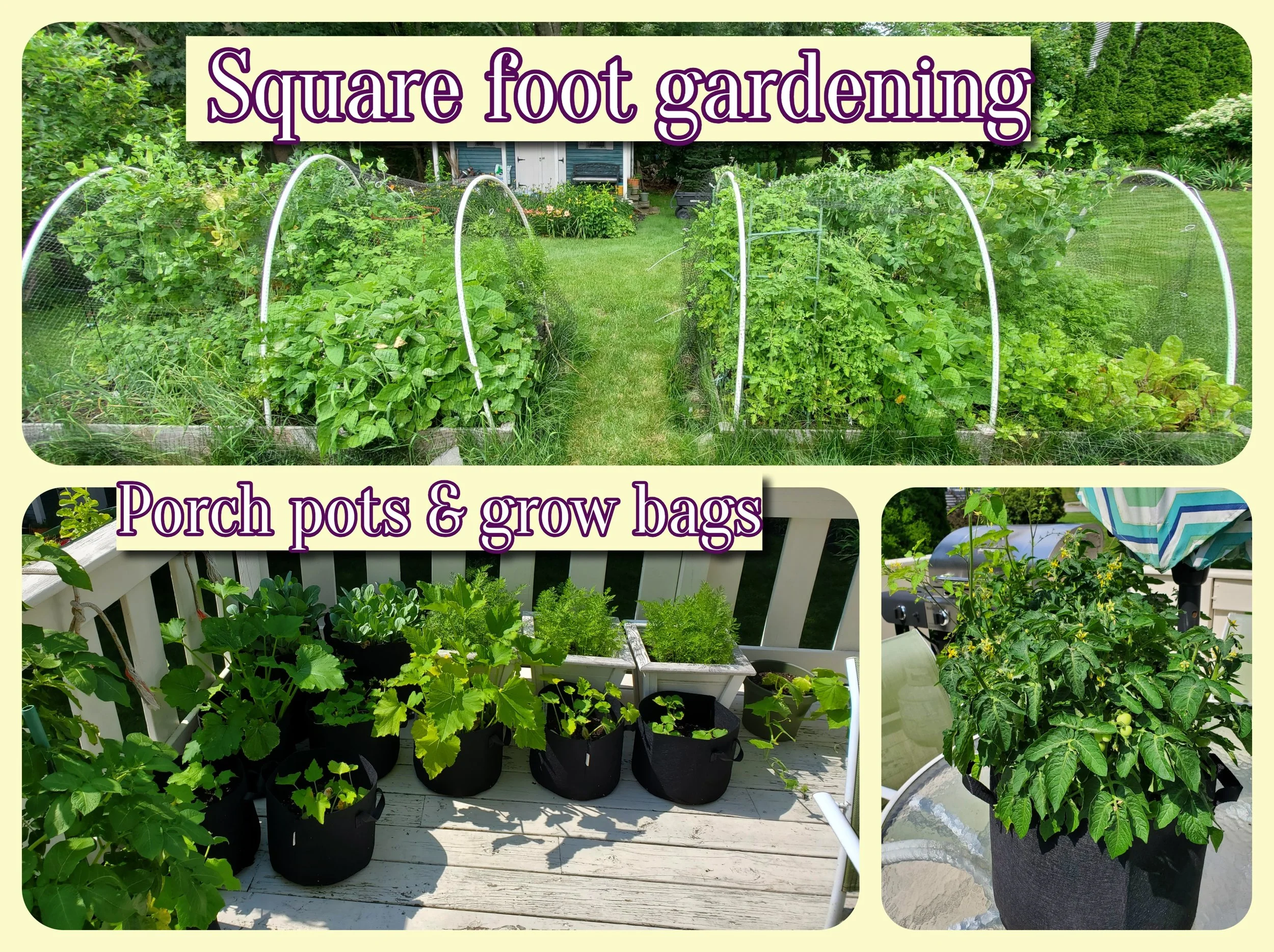
Remember those seedings we started back in April and May? Here they are in late summer. I have two 4x8 ft raised beds, and a whole lotta grow containers on my porch. That’s it!
I’ve never given my gardens grades before, usually just writing notes in my log (you’re still keeping that log, right?). I try new varieties or new arrangements each year, or go with ones that have worked in the past. Trial and error, remember?
Well, this year, they get grades. Obviously it’s subjective based on how I felt they performed and what I yielded. With a record-setting rainfall this summer, I had some troubles. If it’s not a drought, it’s insects, or soggy rains. Mother Nature does what Mother Nature does.
So here is my roundup! How did your vegetables do this year?
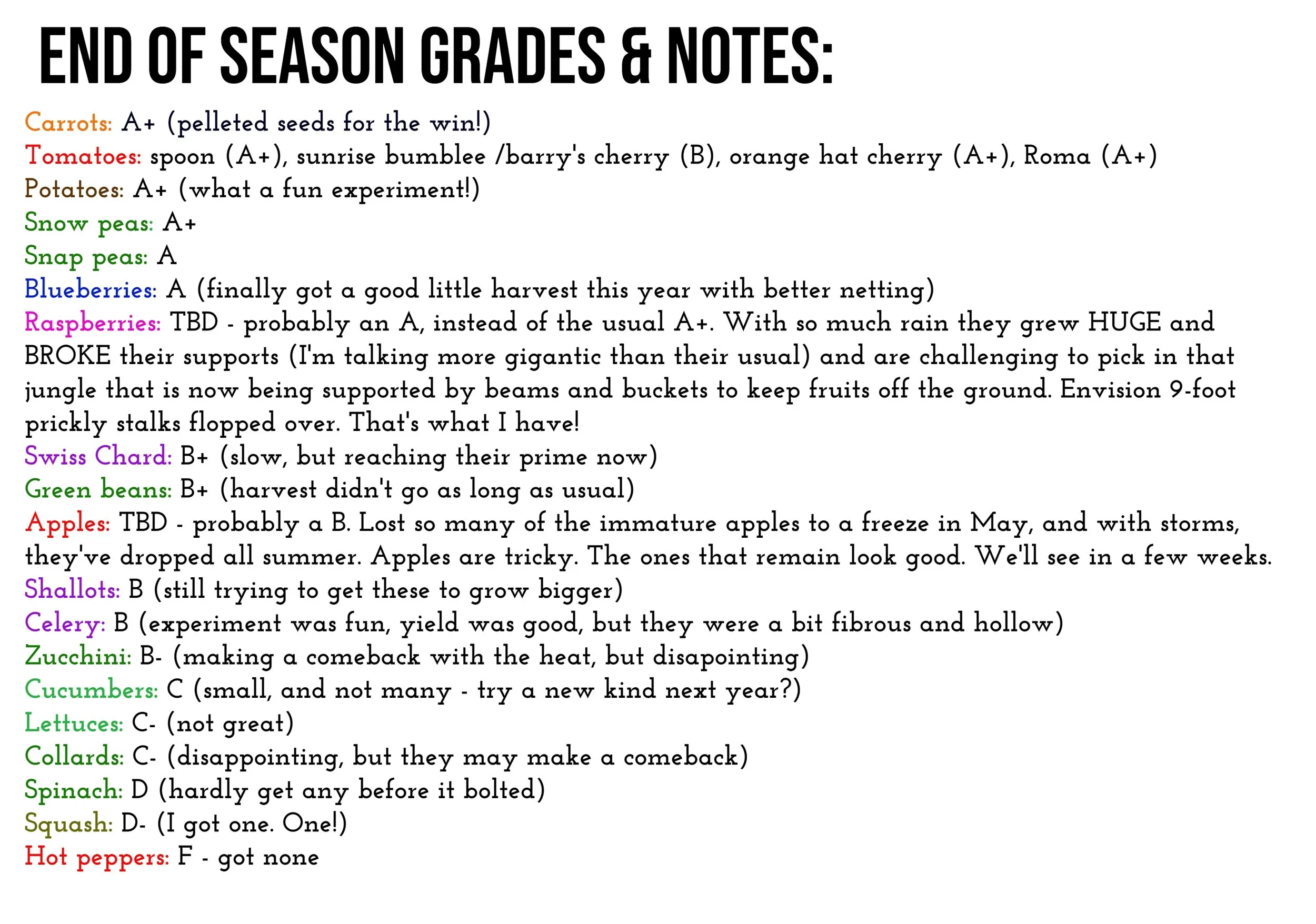
October update….dropping my raspberry score to a C- (and they usually are an A+). Though the quantity is A++, the quality is D-. One out of every 5 are usable due to likely fungus (botrytis) - so many are mushy, rotting, or speckled with gray-black-brown mold. Likely this is from the insurmountable rains this year (we’ve had over 2 feet I think in this area). Sad to see. Can salvage some and when we actually have a few dry sunny days, they are much better, but our wet days have outnumbered the dry/sunny since spring. Hoping next year we are back to “normal.” Likewise, my collard greens just never took off and got eaten up by bugs, a first. Not sur if the location (grow bags) had anything to do with it. Making notes for next year!
Have specific gardening questions? Drop me an email through my website contact form. Join me next time to talk about vegetable harvests and fall pruning/planting.
More in the series:
Part 1 (June): Setting up Vegetable Gardens
Part 2 (July): Setting up Perennial Flower Gardens
Part 3 (August): Fruit Extravaganza!
Part 4 (September): Harvesting your Veggies & Planting for Late/Second Harvests
Part 5 (October): Pruning Your Perennials and Preparing For Winter (veggies & flowers)